Really two countries

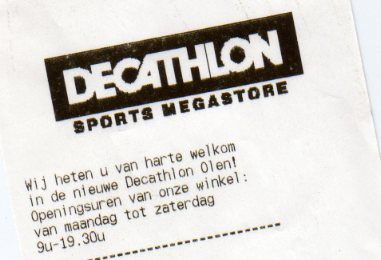
Learning from receiptsThis receipt is from a French sport­ing goods chain store in my sister’s town. The entire receipt is in Dutch (Flem­ish), except for the descrip­tive slogan.

Bel­gium is divided into French– and Flemish-speaking parts. They don’t get along very well, in gen­eral. Both parts are very mono-lingual, as far as things like sig­nage and avail­able printed materials.

This is inter­est­ing to me, in light of Canada’s very bilin­gual pack­ag­ing and sig­nage, in spite of the rel­a­tively small por­tion of French-speaking peo­ple. And most all pack­ag­ing in Switzer­land has their four major lan­guages on it.

Cul­ture and pol­i­tics do affect communication.

Let her sleep

I have a story for you.

When Heather and I first went to Africa (1991), we were part of a 3-month-long train­ing pro­gram that was designed to help us love Africa. And adjust to liv­ing there. Part of our train­ing involved liv­ing with a fam­ily in rural Kenya for two weeks.

It was a stretch­ing time, to say the least. We still keep in touch with one of the fam­ily mem­bers — which shows you it was a good expe­ri­ence, overall.

Any­how, they ate din­ner start­ing at about 9 pm. We were pretty tired by that time of the day, and lis­ten­ing to lively con­ver­sa­tion in Kikamba (their lan­guage) for sev­eral hours was not always our choice of a relax­ing way to end the day.

So one night — about halfway into our two weeks with them — just before din­ner, Heather and I were chill­ing in our small room. Our guest knocked on the door to say it was din­ner­time. I went to din­ner alone. I said, “In our cul­ture, it is wrong to wake some­one when they are sleep­ing.” They bought it — after a lit­tle dis­cus­sion on my part.

I knew she needed a break.

Ignorance is bliss

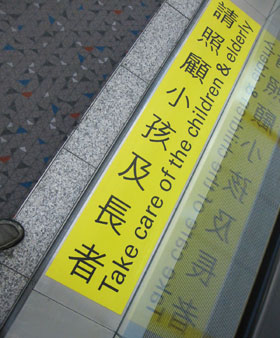
This sign appears next to esca­la­tors in the Hong Kong Airport.

What they meant was, “Make sure that you help chil­dren and elderly peo­ple nav­i­gate this esca­la­tor safely.” (True, my long ver­sion would not work in that space.) How­ever, the translator’s lack of knowl­edge of the finer points of Eng­lish may have been a good thing. Per­haps this sign caused a few Eng­lish mother-tongue speak­ers to increase their car­ing for the chil­dren and elderly with them.

Language is important

You know that.

But I’m remind­ing you. Vis­it­ing another coun­try, where your lan­guage is not the pri­mary lan­guage, is a good way to remem­ber that lan­guage is important.

In Malaysia, Bahasa Malay is the main lan­guage. Eng­lish is very com­mon, but Bahasa is the pre­ferred way of communicating.

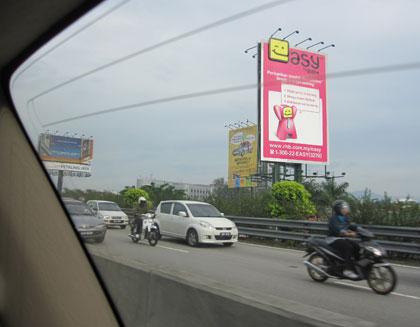
Easy” is a cam­paign or prod­uct for one of the banks there. I had to ask a local what the bill­board (and store­fronts) were adver­tis­ing. The non-verbal cues were not enough for me to fig­ure it out. (Appar­ently, it’s a form of quick banking.)

Inter­est­ingly, in Kuala Lumpur, some adver­tis­ing is in Eng­lish, and some is in Bahasa. I guess it depends on the tar­get audience.

Polkatex?

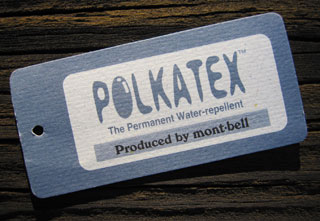
I bought a fancy Japan­ese umbrella by Mont Bell.

Fab­ric? Polkatex! I love the name — it brings a smile to my face. How­ever, it might not com­mu­ni­cate “strong water­proof fab­ric” in Amer­ica like it might in Japan.

Sadly, when the user opens the umbrella, each strut has to be snapped into place — a small has­sle. But it’s com­fort­ing to know that the water­proof­ing will last a long time!

Forever changed

Wananchi” is the Swahili word for “peo­ple”. We lived in Kenya for five years. I heard “wananchi” a lot. (Gen­er­ally, in African cul­tures, the whole is more impor­tant than the indi­vid­ual — the oppo­site of in Europe and Amer­ica. Again — gen­er­ally speaking.)

So when­ever I see “Wan­chai”, my brain con­verts it to “wananchi”. Our time in Kenya for­ever changed us, and this is just a small example.

Bank holiday

bank-holidayToday is a bank hol­i­day in Amer­ica — Memo­r­ial Day. I’ll let oth­ers write about its significance.

A national hol­i­day in the UK, is referred to as a “bank hol­i­day”. In the US, it’s “national hol­i­day”. A break from work of sev­eral days in the UK is a “hol­i­day”. In the US, it’s “vacation”.

Whichever the case for you, I hope you enjoy this day!

Plain language

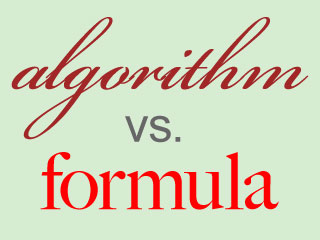
algo-v-formulaThere is ten­sion. A friend strongly advo­cates the use of plain lan­guage in com­mu­ni­cat­ing. I tend to agree. In fact, there is a whole move­ment around this idea.

When I’m writ­ing for this blog or for work, I always try to use words that com­mu­ni­cate the most sim­ply. Why use flow­ery words when plain words will com­mu­ni­cate faster?

Heather and I received bal­lots from our local gov­ern­ment for a small elec­tion issue. The bal­lot was worded by lawyers (who are not known for plain lan­guage). It was not under­stand­able by either of us. (Heather has a master’s degree, and I have com­pleted three courses towards one, so we’re not dumb.)

Back to the ten­sion... my sis­ter Sharon says that this move­ment is “dumb­ing down” Amer­ica. Her pro­fes­sion lies in the health care field, and she feels many impor­tant details are lost when prob­lems are explained to patients. This is true in many other pro­fes­sional realms.

Which side do you fall on?