
Fun vs. Practical

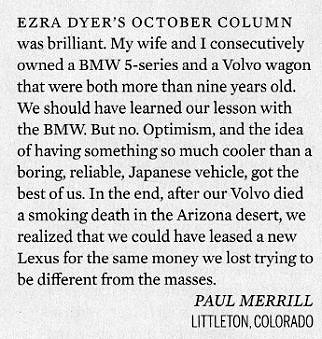
Letter to Automobile magazineThis let­ter appears in the Decem­ber 2011 issue of Auto­mo­bile Magazine.

I love writ­ing let­ters to the edi­tor. This is my 15th or 16th let­ter to get pub­lished in a national or inter­na­tional mag­a­zine. I get a buzz out of see­ing my name in print. Ego­tis­ti­cal? Maybe. (For­give me for that, if it’s true.)

Roughly the same amount of time it would take for you to com­ment on a blog post — and have 21 peo­ple see it — can yield a few more views, if your thoughts are pub­lished in a mag­a­zine. Print may be dying, but there is still a good num­ber of peo­ple who read printed mag­a­zines. Obvi­ously, I’m one.

If you’d like to read more of the dead Volvo story, it’s in my pre­vi­ous blog.

And here’s Ezra’s col­umn. The Decem­ber Auto­mo­bile Let­ters to the Edi­tor sec­tion had more let­ters about that col­umn than I’ve ever seen focus­ing on any arti­cle or col­umn before.

One step forward, two back

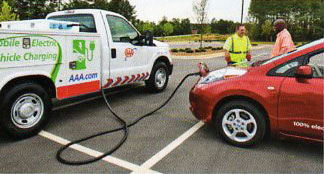
Mobile charging stationI doubt if you read Autoweek mag­a­zine. That’s why I’m shar­ing this story from the Octo­ber 31, 2011 issue.

AAA now has trucks devoted to charg­ing stranded elec­tric cars in six dif­fer­ent US cities. At the moment, that would only be two vehi­cles — the Nis­san Leaf and the Mis­tubishi i. And there are maybe 25 actual cars float­ing around the US. So it’s a near-future-oriented program.

Any­how, I was amused at the thought of a rel­a­tively low fuel econ­omy truck being dri­ven across town to charge up an “ultra-green” car. It kind of defeats the purpose.

Another strange thing is that the trucks charge up the cars to travel another 3–15 miles ... to “reach a charg­ing sta­tion.” Good luck find­ing a charg­ing sta­tion. You might know that most fully-electric cars take about 24 hours to charge from a reg­u­lar house­hold cir­cuit. (A devoted 240– or 480-volt out­let drops the full charge time down to 3–6 hours.)

My con­struc­tive sug­ges­tion? Use a much cheaper tow truck and tow the car to the owner’s home. Or an office or store that has an elec­tric exten­sion cord.

Elec­tric cars aren’t ready for prime time. Yet.

Chevrolet Sonic Review

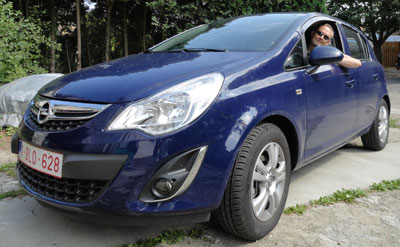
Opel CorsaThe Opel Corsa is the Euro­pean ver­sion of the USA’s Chevro­let Sonic.

The Corsa (shown) is a great lit­tle car. Our fam­ily of five did a day trip of 160 kilo­me­ters (100 miles) across Bel­gium and Hol­land with­out any prob­lem, in spite of the rel­a­tively small size. The feel­ing of qual­ity was evi­dent in all the con­trols, how solidly the doors shut and in my gen­eral per­cep­tion of the com­po­nents being substantial.

The Corsa/Sonic han­dles well. It was quite com­pa­ra­ble to the Ford Fiesta I drove a few days before dri­ving the Corsa.

Sadly, the Sonic has an ugly front end, but it’s still a good car — far bet­ter than the Aveo, which it replaces in the Chevro­let line-up. The Aveo was based on a rel­a­tively cheap qual­ity Suzuki.

A huge dif­fer­ence between the car you can buy in Europe and the USA model is more than cos­metic — the Euro­pean mod­els can be bought with diesel engines. In the 1.3 liter model we rented, I recorded about 43 miles per gal­lon. Accord­ing to Opel’s web­site,* the gas (petrol) model gets about 23% less fuel econ­omy. (And the Sonic will get even less fuel econ­omy than the Euro­pean gas model.)

I found the power from the small tur­bod­iesel to be more than ade­quate. We’re not talk­ing sports car ter­ri­tory, but it had more power than our Toy­ota Corolla, which has an engine that is almost 1.5 times big­ger than the Corsa’s.

I’m just sad that Amer­i­can cars don’t get such great small engines — when they are already being made and sold in the rest of the world.

And finally, here is a great arti­cle on why Amer­ica just doesn’t get diesel cars, from Auto­mo­bile Mag­a­zine. (It’s a PDF. And copy­right par­dons, please. And for­give the poor qual­ity of the scan; I spilled water on the page.)

* Note that this link is to the Vaux­hall Corsa, England’s ver­sion of the Opel Corsa.

Recapturing that lost childhood

Matchbox Mustang No. 8Dur­ing the sum­mer, I saw an amaz­ing toy car col­lec­tion worth thou­sands of dol­lars. It was not in a museum — but in a home office. Few peo­ple beyond the col­lec­tor, his wife and daugh­ter ever see these cars.

So why would he invest so many hours and and so much money in that? (One small set alone is worth about $1,000.) My the­ory is that he is try­ing to recap­ture some of his lost child­hood. He remem­bers when he saved up and bought those cars when he was a kid. As a pro­por­tion of his income, the lit­tle cars might be sim­i­lar in what they cost him today, maybe.

I col­lect lit­tle cars (in spite of my pri­mary empha­sis on col­lect­ing dig­i­tally). I don’t pay very much for them. I don’t col­lect very many. But to any­one who vis­its my home office, they will see prob­a­bly 6 or 7 lit­tle cars lined up, look­ing at me. Am I try­ing to recap­ture some of my lost child­hood? Maybe. Mostly I just like cars and it’s fun to see those lit­tle cars every day.

What’s the dif­fer­ence between the pre­vi­ously men­tioned col­lec­tor and me? He goes to great lengths to find spe­cific mod­els. He’s will­ing to pay a ton when he finds the pearl of great price. I just ran­domly pick up a Tra­bant when I see it at Wal­greens. Or a friend will give me a Mini.

By the way, the model shown is from the amaz­ing col­lec­tion. (He very kindly let me take sev­eral  pic­tures — which are in now my dig­i­tal col­lec­tion.) That Mus­tang is one that I owned when I was a boy. Today on eBay with the box it costs $100. Sadly it won’t regain a place of honor in my collection.

It’s all about context

MangosteenWhen we were in Lon­don, we stopped into Harrod’s. My sons loved the food hall that had a large selec­tion of exotic fruit. If you were will­ing to pay, you could sam­ple all man­ner of fruits, flown in from very far away.

I had to take a photo of the man­gos­teen — £32 for a kilo — or about US $ 52, as of this writ­ing. My dear friends in South­east Asia pay quite a bit less. But sit­ting on a trop­i­cal patio eat­ing man­gos­teen is a lot dif­fer­ent than sit­ting in a cramped apart­ment in grey Lon­don, enjoy­ing (nearly) the same taste. And maybe to some­one who sorely misses their home near the equa­tor, that taste would just about be worth it.

We also saw an unbe­liev­able num­ber of exotic cars. The high­light was a Bugatti Vey­ron, worth about $1,500,000. Just dri­ving on the street. The guy behind the wheel was maybe on his way to get a litre of olive oil at the near­est super­mar­ket. Dri­ving that car was an ordi­nary part of his day. For me, it would be an expe­ri­ence to remem­ber for the rest of my life.

Con­text.

Tesla in Colorado

Tesla makes very fast elec­tric cars. Very fast expen­sive elec­tric cars.

Boul­der has had a show­room for a while, but Den­ver recently got one — in a mall! (Funny enough, the Boul­der store is now miss­ing from their deal­er­ship list­ings page.)

The store is small. Just two cars are on the floor. But at $140,000 each, I’m not surprised.

The Road­ster is the only model cur­rently avail­able. It’s basi­cally a Lotus Elise at more than dou­ble the price. That’s a lot of sav­ing the whales you can do for the difference.

A really really bad car

Nis­san recently came out with a two-door con­vert­ible SUV — the Murano Cross­Cabri­o­let. It gets bad fuel econ­omy, car­ries lit­tle, per­forms poorly, looks ugly, is hard to see out of and doesn’t do off-road very well. And it looks ugly.

A reflec­tion of how hard this vehi­cle is to cat­e­go­rize is that Car & Dri­ver mag­a­zine and Auto­mo­bile mag­a­zine both gave it really unusual reviews. One was an epic poem — “The Odd­ity”. The other was a Q & A, in which the review­ers asked, “Does it do this well?” for 4 dif­fer­ent cat­e­gories, and the answer in every case was: “No.”

(My apolo­gies if you just bought one. And also, please know that I have noth­ing against the reg­u­lar Murano.)

The photo came from Car & Dri­ver magazine.

Big brother?

Audi’s new A6 uses GPS and Google Maps to antic­i­pate hills — so it knows when to upshift or down­shift the trans­mis­sion at just the right sec­ond. (Mil­lisec­ond.) This increases per­for­mance and efficiency.

So the inter­net is even creep­ing into your future car’s transmission!

I do not say this in an alarmist man­ner. Rather, I see it as an excit­ing thing. This is tech­nol­ogy being used well.

I think it’s even cooler when tech­nol­ogy like that is used to bring clean water to peo­ple who might oth­er­wise die. A friend of a friend, Erik Hers­man, is doing stuff like that for Africa.

(By the way, I do have a big brother, in real life. He’s great. And by the way, this ver­sion of the A6 will hit US show­rooms late in the sum­mer of 2011. Stand in line now... just kidding.)

My dream car, for sale

Yes, I love this car. I’m sell­ing it because we already have two cars. And it’s not our car. (I’m sell­ing it for a fam­ily who left the coun­try to live in South­east Asia.)

Here’s my descrip­tion in the Craigslist ad: 2.4 liter 5-cylinder. EXCELLENT con­di­tion!! Loaded with leather, sun­roof, & 3rd-row seat. 178k but VERY well-maintained, many ser­vice records, recently new tires, tim­ing belt changed at 108k. Recent work: replaced front struts & bush­ings, replaced front CV boots, upper engine mount, right front ball joint, new wind­shield, front brake rotors turned & new pads.

I’m ask­ing $5,400. The only one I could find listed out there in internet-land is one from Wash­ing­ton state with 118k miles — at $8,950!

Update: A fam­ily bought it. They love the car. It was a plea­sure to see their joy.

Transmission overkill

merc-9spThe 2012 Mer­cedes S-Class sedans will have 9-speed trans­mis­sions. The idea is for them to have the smoothest and qui­etest shifts you can get.

To me, it’s overkill. Yes, refine­ment is great, but it is worth the extra expense? Our Honda mini­van has a 5-speed trans­mis­sion, which is won­der­ful. At high­way speeds, it’s purring along at a very low rate of rpm’s. Our Toy­ota sedan makes do with just a 3-speed. That both­ers me a bit, know­ing that it would save some fuel if the engine spun at lower rpm’s in top gear.

I remem­ber 10-speed bicy­cles being an inno­va­tion in the USA. My 1972 Gitane road bike came with a 10-speed. I upgraded it to a 12. Today most road bikes have 27 speeds. I’d be happy with 18. (Actu­ally, I am happy with 12 — but I’d appre­ci­ate the dif­fer­ence 18 would add to my cycling experience.)